Hello, and welcome to my blog.
Over the next series of posts I will be providing some critical insight into the way in which a city and its people, its government, and resources try and deal with the environmental issues that they face on a day to day basis.
The blog will focus on contemporary issues that are facing the city on a as-near-to-possible real time basis, but some reference to historical issues and the ways in which they were dealt with will be reflected upon at times.
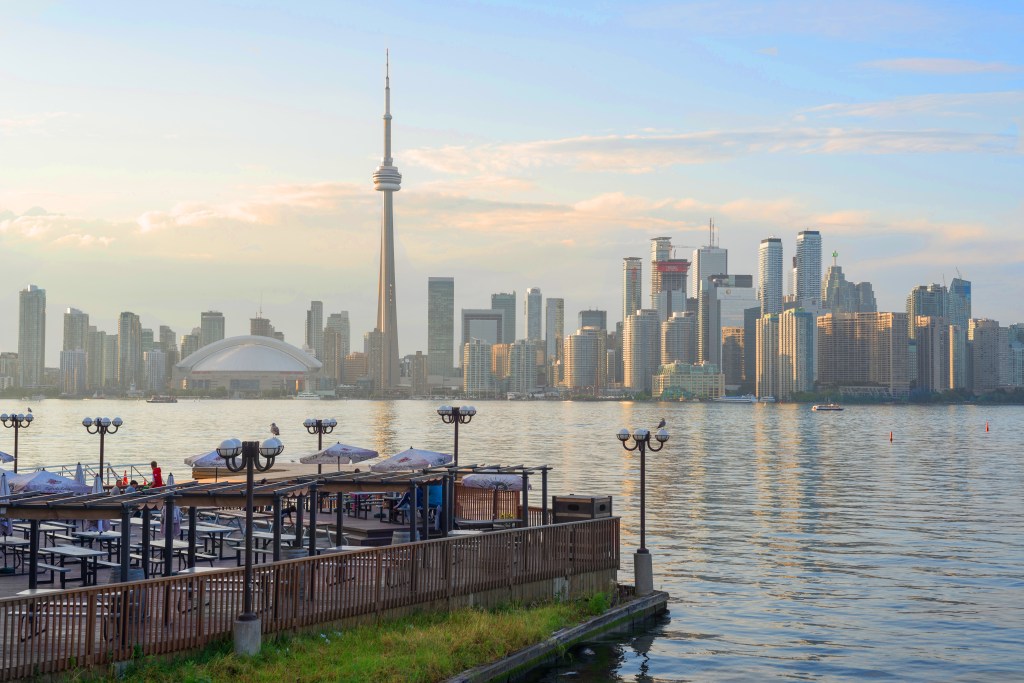
A. Vagen (2017) ‘Toronto seen from Toronto Islands’, Own Work.
My inspiration for choosing Toronto as the city for my research is based upon two elements. First of all, it is a city that I have previously visited during my childhood, and one where several members of my extended family have lived and currently reside. An interest in the city has thus remained since a young age, with this blog being the apt opportunity to explore the city in more detail, with a geographical perspective and understanding. Secondly, Toronto is the most populous city in Canada, with over 2.7 million residents as of 2016 (Statistics Canada, 2017). As well as a large population, the city is also a globally significant city, ranked Alpha by the Globalisation and World Cities Research Network’s classification (GaWC, 2018). This means that it is considered to be economically and culturally critical in a global context, with diversified industries in technology, banking and finance, education, the arts and tourism. It is expected that over 43 million tourists visit the City every year (City of Toronto, 2019).
The combination of a globally significant city that is considered to be highly developed, high levels of tourist interactions and similarities across Western society, means that the analysis that I will be conducting throughout this series of blogs can be comparative between cities that in statistics seem to be similar. In the sense of urban political ecology study, it is fair to say that from afar Toronto appears to fit the discourse of the Western, developed city, which has few infrastructural and environmental concerns. However, it may turn out that through deeper consideration, that there are issues that any city could face, whether they be located in the Global North or South, developed or developing.
Another key factor to consider is the diversity that characterises Toronto. More than 20% of the population belong to a visibly minority group, with over 200 countries’ ethnic origins being represented within the city, and 160 languages (City of Toronto, 2015). Toronto thus provides a potential urban political ecology lens for which critical analysis can be undertaken. Within a city of many users, and many differing ideals of service provision and futures, contestations are likely to occur between individuals, communities, governance and businesses, with power struggles existing between them. Toronto’s high levels of urbanisation and development means that there are high levels of flows through the city and high levels of ‘urban metabolism’.
There is a complex relationship between ‘nature’ and ‘cities’, one that is deeply politicised (Heynen, 2014), which will be explored throughout this series of blog posts, ranging from topics ranging from air pollution to water provision, to provide just two examples. Each blog will set the scene and then discuss an environmental issue critically through an urban political ecology lens.
Reference List
City of Toronto. (2015). Diversity – Toronto Facts – Your City. Available at: https://web.archive.org/web/20150406180836/http://www1.toronto.ca/wps/portal/contentonly?vgnextoid=dbe867b42d853410VgnVCM10000071d60f89RCRD&vgnextchannel=57a12cc817453410VgnVCM10000071d60f89RCRD Accessed on: 07/02/2020.
GaWC. (2018). City Link Classification 2018. Available at: https://www.lboro.ac.uk/gawc/world2018link.html Accessed on: 07/02/2020.
Heynen, N. (2014). “Urban political ecology I: The urban century.” Progress in Human Geography 38(4): 598-604.
Statistics Canada. (2017). 2016 Census. Available at: https://www12.statcan.gc.ca/census-recensement/2016/dp-pd/prof/details/page.cfm?Lang=E&Geo1=CSD&Code1=3520005&Geo2=PR&Code2=35&Data=Count&SearchType=Begins&SearchPR=01&B1=All Accessed on: 07/02/2020.
Other useful links:
https://www.toronto.ca/city-government/accountability-operations-customer-service/long-term-vision-plans-and-strategies/strategic-plan-2015-2019/ – Link to Toronto Public Health Strategy 2019-2020.
https://www.torontoenvironment.org – Toronto Environmental Alliance, a non-profit organisation that acts a watchdog and campaigner that advocates on behalf of, and encourages engagement from, Torontonians.
Word Count: 558.
 Urban Political Ecology