According to the World Economic Forum, Amsterdam has the 12th most trees of any city with 20.6% of the city populated with them. However, when it came to cities with the highest percentage of green spaces, Amsterdam did not make the top 20. With only 13% of Amsterdam covered in public parks and gardens, compared to Moscow’s 54%, and London’s 33%, it trails very far behind major European metropolises. Green spaces in urban settings have social, economic, cultural, and environmental dimensions in sustainable development. They improve air quality and cool buildings/areas in urban spaces (Haq, 2011). The relationship between nature and the built environment in Amsterdam hints at questions of not only ecological betterment but also environmental equity for all city-dwellers.
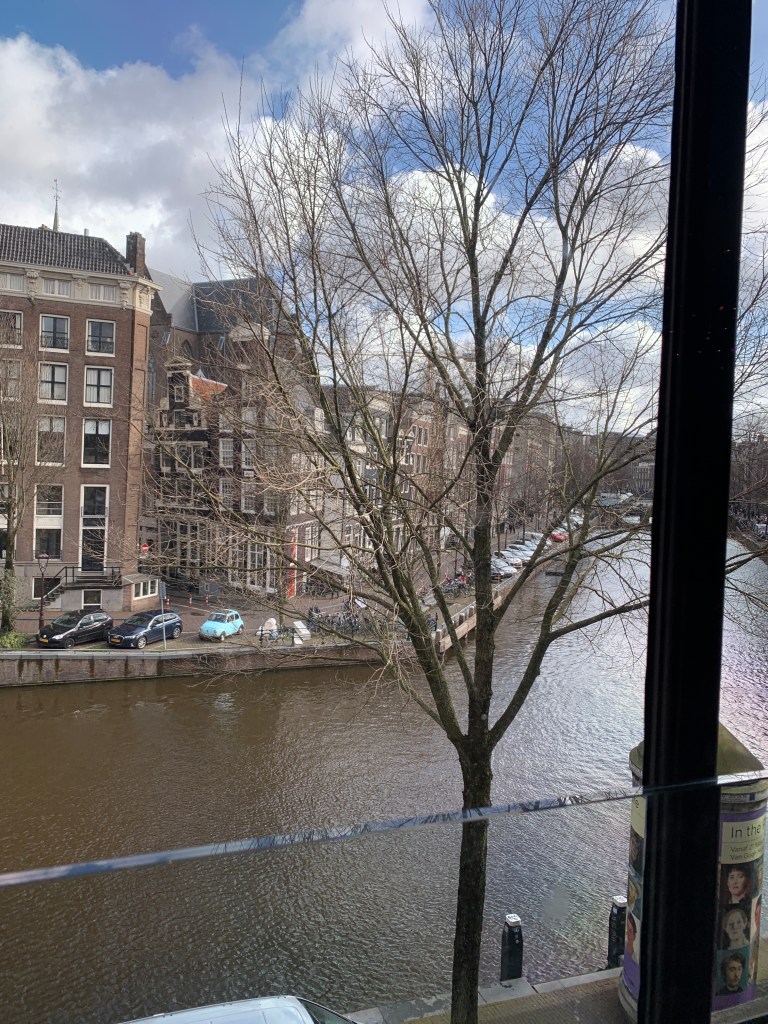
Visiting the Grachtenhuis Museum in Amsterdam, I was struck by the continuous mention of Amsterdam as a green city: it was described as one full of green spaces, written into the initial architectural design of the city. The lack of public green spaces in place, but the paradoxical abundance of trees can be linked to the historical prominence and grandeur of canalhouse gardens.
A quick historical recap: during the 1600s, issues of population increase and density forced the city to be re-designed. This expansion included the addition of three main canals – Herengracht, Keizersgracht and Prinsengracht – with a space for a row of trees along the banks. The architects wanted to maintain an image of stone and nature in balance: ‘the city in the forest, or the forest in the city’ (Albrecht and Grever, 2015: 11). To create this image of a “Green City”, there was an ordinance that banned industry businesses from setting up premises in this area, and to leave spaces for gardens. These gardens were filled with trees, to ensure shade for residents so the class conscious canalside inhabitants could enjoy their tea without getting tanned (ibid, 2015). In those days, pale skin unharmed by the sun was a sign of wealth.
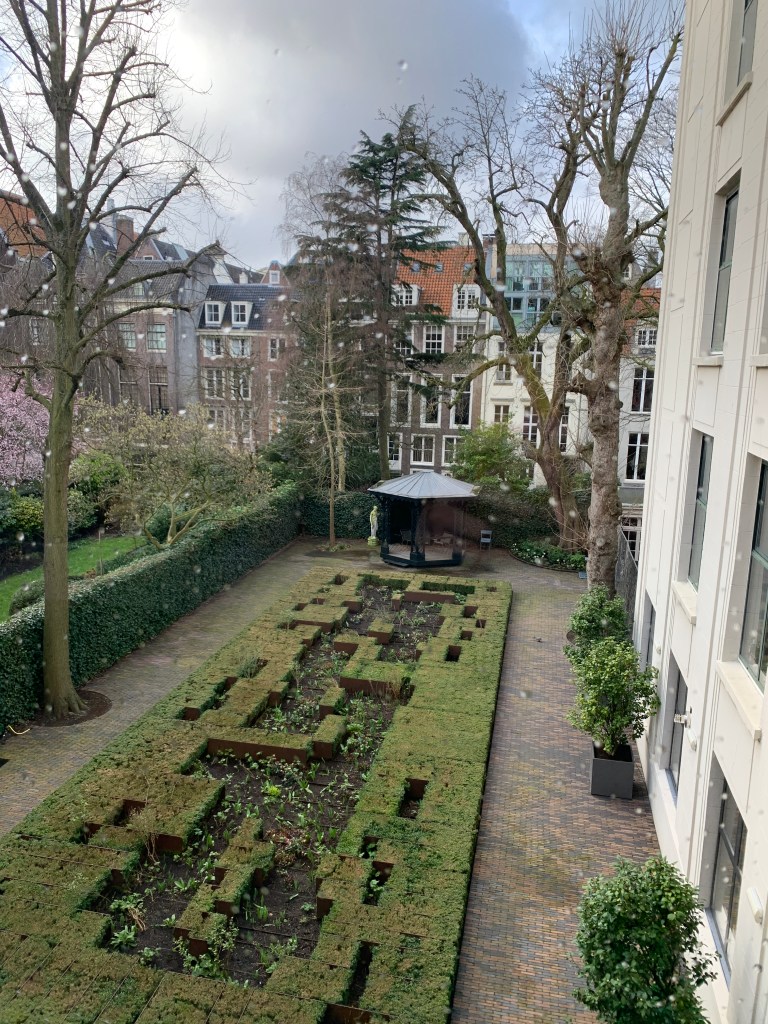
Thus, the city has plenty of trees but a lack of green spaces. The issue here is that due to city blocks being sealed off, this greenery is hidden and visible only to canal side residents, which happen to be the wealthiest residents. Historically, even the help who lived in coach houses at the back of the gardens did not have real windows. This prevented them from looking into their employer’s private gardens (Grachtenhuis Tour, 2019).
What does a lack of green spaces actually mean for Amsterdam?
Urban centres are frequently zones of exacerbated summer temperatures. The built environment creates an ‘urban heat island’ caused by vehicles emitting heat, concrete and asphalt absorbing and radiating heat, and ‘urban canyons between tall buildings trapping heat at the street level’ (Oldfield, 2018:2). The usual response to the increasingly common heat waves in cities is to crank up the air conditioner, but that involves the vicious cycle of heating the outside to cool inside.
The best solution for cities is, you guessed it: public green spaces. Vegetation and greenery provide shade and stimulate evapotranspiration cooling the environment as well as absorb pollutants from the air and provide residents with aesthetic and calming places to relax.
Amsterdam might have to consider creating more of these places, given that over the last few years the heat waves have shocked it. In 2019, they hit 40 degrees Celsius, for the first time in recorded history (Ambrose, 2019). Unused to this, the cities’ residents panicked. I remember my sister calling me in a panic, asking me to ship her a fan because they were sold out in every store and on back-order online. That summer, Amsterdam experienced two heat waves. A smog warning was released by the public institute (RIVM), and suggested limited physical activity, especially in the mornings and evenings when pollution levels were highest. A total of 2,964 people died (Pieters, 2019).
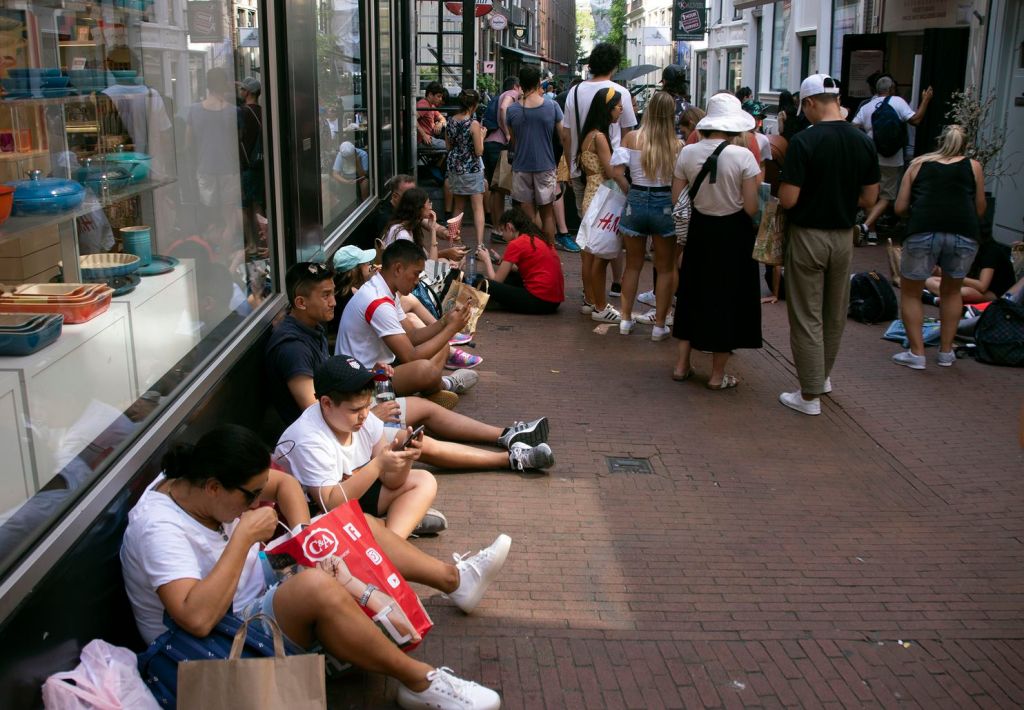
Despite being viewed as a ‘Green City’, Amsterdam trails behind many other major urban centers when it comes to actual greenery. This image vs. reality contradiction ties into the issues of complacency in the residents of the city, which I have spoken of in other entries. It also reveals the ‘class character’ that underpins socioenvironmental injustices (Bridge, 2008: 572). In the name of harmonious coexistence of urban and rural conditions that are inclusive to all within this city, Amsterdam needs to create more public green spaces to accompany Vondelpark.
Word Count: 733
References
Albrecht S. and Grever, T. (2015) Canal house gardens of Amsterdam: The Hidden Green of the City W. Books: Zwolle, Netherlands
S. Haq, “Urban Green Spaces and an Integrative Approach to Sustainable Environment,” Journal of Environmental Protection, Vol. 2 No. 5, 2011, pp. 601-608
Maina Wambugu, Daniel . (2018). Cities With the Most Green Space. Retrieved from https://www.worldatlas.com/articles/cities-with-the-most-greenspace.html
Garfield, L. (2018) These are the 19 cities with most trees, World Economic Forum. Retrieved from: https://www.weforum.org/agenda/2018/03/the-12-cities-with-the-most-trees-around-the-world
Oldfield, P. (2018) What would a heat proof city look like, The Guardian. Retrieved from: https://www.theguardian.com/cities/2018/aug/15/what-heat-proof-city-look-like
Pieters, J. (2019) 400 more deaths during heat wave than average, NL Times. Retrieved from: https://nltimes.nl/2019/08/09/400-deaths-heatwave-average
 Urban Political Ecology
This was an extremely insightful entry. I have always thought of Amsterdam as one of the leading green cities, as this is the image they present. It really highlights how we should always question claims about sustainability as greenwashing has become so commonplace.
In Cape Town many eco estates have been created which provide residents with large areas of green space. The developers emphasise how these developments are green and environmentally friendly. However, similar to the greenery and gardens in Amsterdam, these areas are only benefiting a small number of wealthy people. Amsterdam and Cape Town could learn important lessons from many cities around the world who have successfully increased and expanded green spaces to all areas of the city.
LikeLike
Intriguing that it is framed as a green city despite the lack of public parks and public green space, and that having a garden is still caught up in historical class relations. Like Amsterdam the heat island effect is also found in Las Vegas – due to its desert location having green space is seen as a solution but would be challenging to execute without exacerbating water supplies. It’s interesting to see that cities can suffer from the same problems despite having differing climates.
LikeLike