The acceleration of climate change and the increasing prevalence are arguably the most serious of risks to development of urban areas, providing an ever increasing concern for city authorities and planners (Wamsler, 2014). The increase in prevalence means that there is a greater risk of greater social and economic losses as a result of a disaster, hazard or climate change.
Growth in urban disaster statistics is typically explained by the rapid expansion of cities, in size, in population and also density with many examples, especially in the developing world, where between 2000-2015, 65 million are added annually, 93% in developing countries (Pelling, 2003). Population growth and the increasing sprawl of cities may be too simplistic to explain the increasing prevalence of disasters and their greater impact, as they represent a neo-Malthusian explanation where population growth has a direct link to environmental impacts as well as risk increasing (Coleman and Schofield, 1986).
This blog will use the ice storms of 2013 to highlight the ways in which Toronto deals with nature hazards, and also how cities adapt, attempt to minimise risk and increase resilience.
Nirupama et al.’s publication (2014) provides an overview over historical and contemporary hazards impacting Toronto and Ontario as a region.
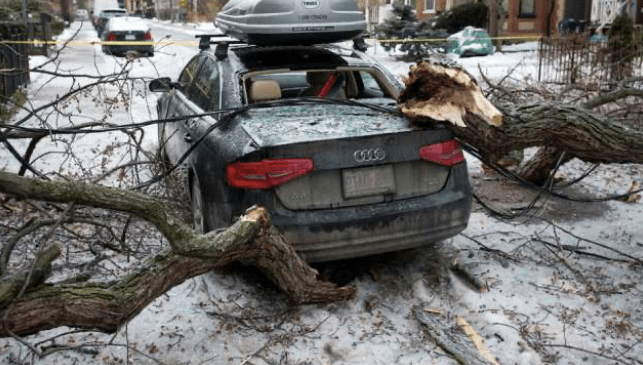
Toronto was the hardest hit by the 2013 ice storm in North America. The storm produced a layer of ice that caused damage to ecology, property and infrastructure (Armenakis and Nirupama, 2014). Freezing rain fell and created ice of greater than 6mm, the level for it to be classed as an ice storm. Total ice accretion came to around 30mm over 20-21 December 2013.
Perhaps the most telling impacts were felt on urban forestry and infrastructure. Trees which were already fragile due to the time of year, and damage to these brought down power lines, leaving over one million people without power (Nirupama et al., 2014). The impact on power sources meant that traffic systems, urban transport and telecommunications were significantly disrupted. These highlighted vulnerability within the city. Traffic collisions increased massively and people’s mobility was reduced due to decreased transport services.
Health risks also exponentially increased. Two hospitals were running on back up power supplies, injuries due to slippages increased, and carbon monoxide poisoning from generators was reported (Schwartz, 2014).
In response, emergency help centres were set up across the City, providing accommodation, food and cleaning facilities for those most affected by the power outages. It took over a week for full power to be restored to all across the region (Armenakis and Nirupama, 2014).
How this links to urban political ecology is multi-stranded. There is the discussion around how prepared cities, Toronto in this instance, are for dealing with natural hazards. The ice storms of 2013 highlighted some weaknesses and certainly created some lessons to be learnt.
Ecology in this case plays a significant role in not only creating damage, in that trees caused power lines to be damaged, but also their management prior to another storm occurring is critical in minimising the risk and increasing resilience. Managing the tree canopies in urban settings is thus critical, and of course this has knock-on impacts to urban wildlife, habitats and species found within the urban forestries and canopies.
The political and urban sense comes from the response and preparation that the city has to show for future events. The 15,000km overheard power line network of Toronto if made underground could cost as much as $1.5 billion (Armenakis and Nirupama, 2014), but avoids the risk of ice accumulation and damage from trees. But, who pays for this, who benefits most and least, who will have access to upgraded services, are all issues to be considered.
Word Count: 619
Reference List
Armenakis, C., and Nirupana, N. (2014) Urban impacts of ice storms: Toronto December 2013, Natural Hazards, 74, 1291-1298.
Coleman D., and Schofield R. (1986) eds., The state of population theory: Forward from Malthus. Oxford: Basil Blackwell.
Pelling, M. (2003). The vulnerability of cities: Natural disasters and social resilience. Earthscan Publications.
Schwartz, B. (2014) Quote reported by Alex Ballingall in ‘‘ice storm aftermath: four ways Toronto is vulnerable when freak weather hits’’, thestar.com. 10 Jan 2014.
Wamsler, C. (2014). Cities, Disaster Risk and Adaptation. Routledge.
Extra information
Emergency Management Ontario (EMO) is the provincial public emergency agency that is responsible for recording events, and provide plans for people, property and environment.
 Urban Political Ecology