Improving air quality is an issue that many urban cities are faced with. Las Vegas is certainly no exception. Ozone and particulate pollution (PM2.5) are the pollutants that are causing the most problems within the city (Martinez, 2019).
Ozone (O3) is formed by a reaction between molecules of NOx from car exhaust fumes or VOCs (volatile organic compounds) in the presence of UV light. With Las Vegas receiving high amounts of sunlight, elevated ozone levels are virtually unavoidable (Wilson, 2019). However, they can be managed. Ozone irritates the lining of the lungs. In 2018, ozone pollution was responsible for 97 deaths and 114 hospitalisations (Miller, 2019; McFarland, 2019).
Extreme climatic events are becoming more frequent due to climate change. For the West Coast of American drought and wildfires are some of the extreme events experienced. The Californian wildfires in 2018 were the worst on record – with record breaking destruction and devastation. The fires had a knock on effect on the ozone pollution in Las Vegas. So called ‘background ozone’ – or ozone that would be otherwise undisturbed is released through the burning of forests (Rice, 2015). This is then able to move via wind to other locations – such as Las Vegas. This suggests that perhaps the ozone problem is out of control of Nevada state officials.
Extreme climatic events are becoming more and more frequent due to climate change. The severity of the events is also increasing. For the West Coast of American drought and wildfires are some of the extreme events experienced. The Californian wildfires in 2018 were the worst on record – with record breaking destruction and devastation. The fires had a knock on effect on the ozone pollution in Las Vegas. So called ‘background ozone’ – or ozone that would be otherwise undisturbed is released through the burning of forests (Rice, 2015). This is then able to move via wind to other locations – such as Las Vegas. This suggests that perhaps the ozone problem is out of control of Nevada state officials.
Whilst this is somewhat true, progress has been made to reduce point source emissions that could add to the ozone problem. In Nevada state in Clark County (were Las Vegas is located) the Clean Air Excellence Award has been won. This is for the county’s efforts to reduce the number of vehicles on Las Vegas roads through the ‘Club Ride Commuter Service’ (Clark County, 2015). As part of the service citizens are encouraged to car-pool, ride their bikes more often and where possible compress their working week to limit travel. Along with this, map apps have been created to show the routes with the least congestion to stop fumes from idle cars adding to the pollution problem (Clark County, 2015).
Ozone pollution peaked in 2007 and has reduced gradually since then. The was a spike in the severity of the problem in the wake of the 2018 wildfires. The level of ozone is continually monitored and there has now been an emergence of citizens using portable sensors to monitor the air that they are breathing in (Snyder, 2013). Data collection regarding air pollution is often confined to a limited number of locations this is why residents have begun to take matters in to their own hands (Buzzelli, 2008). According to researchers at UNLV – who specialise in air quality in the city, the pollution problem is worse in the less desirable neighbourhoods in Las Vegas (Wilson, 2019). These homes tend to be located nearer to highways and hence the populations are troubled by excess pollutants from the high volume of cars that pass through (Kimborough, 2011). By monitoring the air with personal sensors citizens are better equipped to deal with the problems associated with poor air quality and are more inclined to take action over the issue.
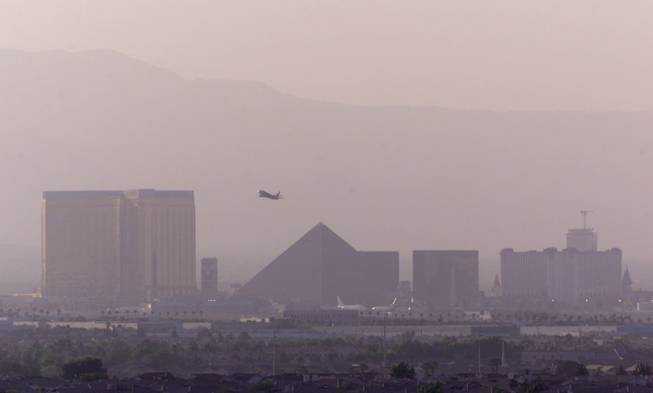
The issue of ozone pollution in Las Vegas is severe. In 2018 numerous deaths happened with an estimated cost in health-care of $898million. Whilst Clark County officials are implementing policy to encourage reduced car use the problem is still likely to persist. Citizens are now taking a more active role in the pollution problem by monitoring the air quality and taking necessary action to ensure their health is not hampered by ozone pollution. Las Vegas’ desert location means that ozone pollution is almost inevitable due to the strong UV radiation. With climate change increasing the instances of extreme weather events the problem is likely to get significantly worse in years to come (Graham, 2015). This suggests that perhaps legislation and action needs to be enforced on a global scale to halt the rapid rate at which climate change is happening alongside local policies.
Word Count: 642
References:
Buzzelli, M. (2008). “A political ecology of scale in urban air pollution monitoring.” Transactions of the Institute of British Geographers 33(4): 502-517.
Clark County (2015) Clark County department of air quality: Ozone advance programme, Progress report
Graham, S. (2015). “Life support: The political ecology of urban air.” City 19(2-3): 192-215.
Kimborough, S. et al. (2011) Long term continuous measurement of near-road air pollution in Las Vegas: seasonal variability in traffic emissions impact on local air quality, Air Quality Atmosphere and Health, 6: 295-305
Martinez, J. (2019) Las Vegas air quality worsened for ozone, particle pollution, (WWW) American Lung Association, Chicago, (https://www.lung.org/local-content/_content-items/about-us/media/press-releases/new-report-las-vegas-air.html, last accessed 13/03/20)
McFaland, K. (2019 Air pollution costing Nevadans millions in health bills, (WWW) KTNV: Las Vegas (https://www.ktnv.com/news/study-air-pollution-costing-nevadans-millions-in-health-bills, last accessed 13/03/20)
Miller, C. (2019) Report says Las Vegas air quality is among worst in America but official cite progress, (WWW) 3 News: Las Vegas (https://news3lv.com/news/local/report-says-las-vegas-air-quality-is-among-worst-in-america-but-officials-cite-progress, last accessed 13/03/20)
Rice, E. (2015) The consequences of forest fires: smoke and ozone, (WWW) B3: USA (http://www.b3strategies.com/2015/10/the-consequences-of-forest-fires-smoke-and-ozone/ ,last accessed 13/03/20)
Snyder, E. et al. (2013) The changing paradigm of air pollution monitoring, Environment Science and Technology, 47:20, 11369-11377
Wilson, M. (2019) Is Las Vegas doomed to poor air quality? Not necessarily experts say, (WWW) Las Vegas Sun: Las Vegas (https://lasvegassun.com/news/2019/mar/10/las-vegas-air-quality-where-are-we-now-and-what-is/, last accessed 13/03/20)
 Urban Political Ecology