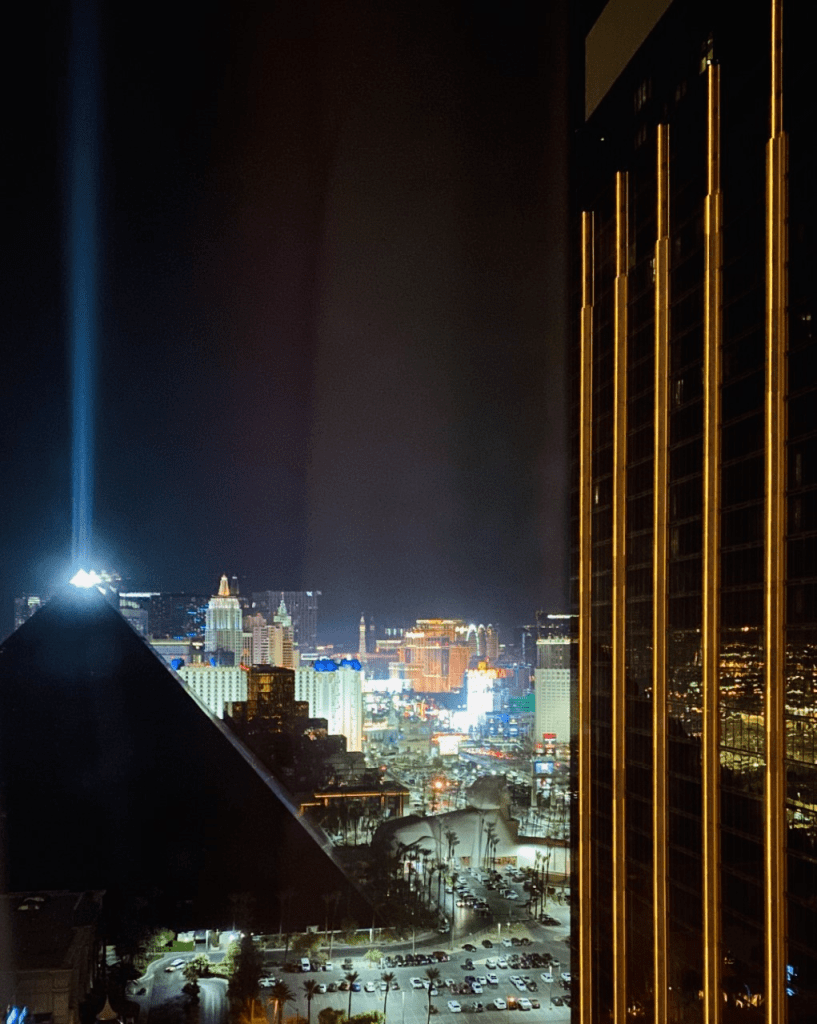
The glittering lights of the Las Vegas strip are no doubt a spectacle to anyone who visits the city. But the lights hold a dark secret – that they’re causing an absurd amount of light pollution!
Light pollution is defined as the ‘wasted light cast in to the atmosphere’ (Ploetz, 2002). Las Vegas certainly casts a lot of light into the atmosphere. So much so that in 1994 a power outage that hit the strip resulted in a vast volume of calls from local residents concerned over a large cloud like object in the sky. That object was part of the galaxy above – which had been obscured from view due to the blinding lights of the city (Drake, 2019).
Not only do the lights mean that people cannot stargaze – which is thought to be beneficial to an individual’s health as it is relaxing (Ploetz, 2002). Excessive light productions has been proven to mess with the biochemical rhythms of the body. Meaning sleep patterns are altered and even more worrying rates of cancer and heart disease are increased.
However in this blog I am focusing on the impact the lights in Las Vegas have on the wildlife. The lights on the strip give Vegas the title of brightest place in the world (Dunn, 2017). Satellites from space are not able to pick up the blue light from LED bulbs, meaning that the city is even brighter than what is reported (Dunn, 2017). This poses challenges to migrating birds who get disorientated by the lights (Van Doren, et al., 2017). Birds are known to fly low and in circular motions in the presence of lights – which compromises their ability to migrate. The lights have also been seen to startle the birds and cause them to fly in to building and high-shine windows. Both of these factors has had an impact on the death rate of birds in Las Vegas (Horvath, et al., 2009).
Despite the negatives, the light that beams from the top of the Luxor Hotel (thought to be the strongest light in the world) has been seen to create its own ecosystem. The light is described as a ‘way-point’ and can be detected by pilots passing over the area (Morris, 2017). Moths, bats and birds of prey flock to the beam. This can be seen in the video below. This has arguably made hunting easier for birds of prey – so perhaps the situation isn’t all bad for the birds.
Concerns over the bright lights and air traffic navigation has led to stricter enforcement of switch off times on the strip. Most of the brightest lights are turned off at 1.30am.
With the ongoing Covid-19 situation the strip has been left in complete darkness – which begs the question, where do the birds find their food now and are the lights creating a level of dependency? This related to UPE as all too often policy is implemented with little consideration of the natural environment living in the unnatural city!
Word Count: 496
Drake, N. (2019) Nights are getting brighter and earth is paying the price, (WWW) NatGeo: Washington DC (https://www.nationalgeographic.co.uk/space/2019/04/nights-are-getting-brighter-and-earth-paying-price, last accessed 02/04/20)
Dunn, M. (2017) Good night, night: Light pollution increasing around the globe, (WWW) Las Vegas Sun: Las Vegas (https://lasvegassun.com/news/2017/nov/22/good-night-night-light-pollution-increasing-around/, last accessed 02/04/20)
Horvath, G., et al., (2009). Polarized light pollution: a new kind of ecological photo pollution, Frontiers in Ecology and the Environment, 7:6
Morris, H. (2017) The casino light beam that’s so bright it has its own ecosystem (and pilots use it to navigate), (WWW) Telegraph: London (https://www.telegraph.co.uk/travel/travel-truths/famous-waypoints-aviation-luxor-sky-beam/, last accessed 02/04/20)
Ploetz, K. M. (2002). Light pollution in the united states: An overview of the inadequacies of the common law and state and local regulation. New England Law Review, 36(4), 985-1040.
Van Doren, B. et al. (2017) High intensity urban light installation dramatically alters nocturnal bird migration, PNAS
 Urban Political Ecology
Interesting post about the impacts of light on wildlife in Vegas. Seems to be a similar situation in my city of choice, Toronto. Several animals but particularly have their migration patterns impacted by the increasing levels of light pollution, especially at night. Around 1-10 million birds are lost each year in the Greater Toronto Area. There are also many human impacts, such as an increase in the likelihood of cancer, and mental health impacts such as staying in darker areas such as the home. Here’s a couple of links if you want to do your own comparison, the second link is about a GIS initiative in Toronto which helps shape local government policies, mainly focused on human benefits.
https://www.nationalgeographic.com/science/2019/04/nights-are-getting-brighter-earth-paying-the-price-light-pollution-dark-skies/
and
https://gogeomatics.ca/environmental-gis-city-of-toronto-light-pollution-initiative/
LikeLiked by 1 person
An excellent example of how LA’s 24-hour culture comes at the expense of the environment. Interesting discussion on how the lights act as both a benefit and disadvantage for the birds. (The video helped to illustrate the movement of birds around the lights, quite a spectacle!).
This neglect of the environment is, of course, a significant issue in many cities, with nature being frequently forgotten amidst the growing need to develop. The creation of 24-hour cities delivers many benefits for the economy and society; jobs, entertainment and increased safety. However, nature and the city are so heavily entwined and therefore, cities need to find a balance between development needs and environmental protection. The government should carry out social and environmental impact assessments for such developments to understand the potential human and ecological impacts. In this case, it is fortunate that the birds are at least gaining some benefit from the lights.
LikeLiked by 1 person
It always surprises me when I read about the relationship LA has with nature. Its urban imaginary seems to be so disconnected with the environment, even though the two might meet physically. This made me think of one of the many futuristic movies that have the city as the setting, Blade Runner. Film-noir like the one mentioned often depicts how the urban space is navigated and the technological approach to urban development. The impacts of LA’s bright lights seems like an expression of the genre in real life. Thank you for the post!
LikeLike
Thank you for this post! I agree with the other comments, that LA seems to be a perfect example of a city as the antithesis of nature in its imaginary. However, precisely because of the links you mentioned with mental health and animal well-being, it cannot be divided thus. To response to your comment about Covid, indeed, how will the sudden change affect all sorts of species? How will less people being around, and thus less garbage/litter, affect the eating patterns of so many urban animals? It seems so careless to assume that our habits haven’t created new characteristics in animals, since there is literally no distinction between the human and the nonhuman on an ecological scale. If this affects these creates, and they migrate elsewhere, how will their absence in turn affect us? What unseen flows are there?
LikeLike