
Figure 1: Candelabra Lily found in Strandveld. (University of Western Cape)
Throughout my exploration of UPE issues in Cape Town, I have come across a variety of delightful images which showcase Cape Town’s beauty. The introduction to this blog series was titled “Beyond the Beauty”. However, now it is time to confront the unique flora and fauna of Cape Town. Unfortunately, this examination of nature is not going to be as pretty as the pictures displayed throughout this entry. Nature in the city is under severe threat due to rapid population growth and urbanisation. The disappearance of Cape Town’s unique biodiversity and the ecosystems they deliver has become a global problem (Holmes et al., 2012).
The Cape Flats Dune Strandveld* (CFDS) located on the lowlands of the city is an endangered vegetation type, only found in Cape Town. Studies have revealed that 40 plant species have gone extinct in the Cape Floral Kingdom since 1990, one of the fastest extinction rates on earth (Wild, 2019). The reduction in groundwater used to facilitate development, the loss of domestic livestock, the arrival of alien species and disruptions to fire regime have severely disrupted the ecology within Strandveld (Lockwood, 2019). Urbanisation has already resulted in the extermination of the eland and many other large mammals. It has left the remaining Strandveld fragmented with only 14% being conserved. Increasing urban growth at the expense of the environment raises many ecological concerns. Can Cape Town find a balance between conservation and development needs?

Figure 2: A Malachite Sunbird Perches Between Aloes in Strandveld (Purves, 2019)
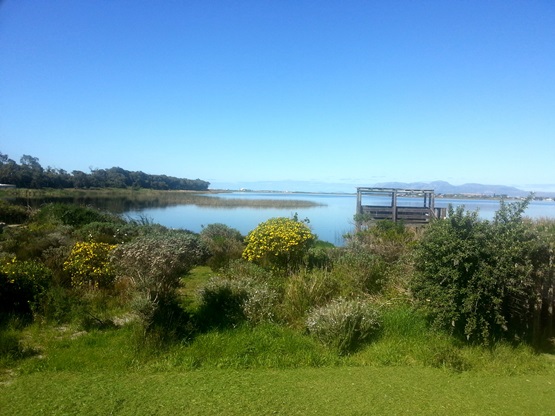
Local action and knowledge have made Cape Town a leading city for collective environmental action, widely recognised for their conservation practices. One example is the Bottom Road Sanctuary conversation project which demonstrated how local, indigenous knowledge and genuine care for the environment can undermine governmental action. The Grassy Park’s residents transformed plots of land, often described as rubbish dumps into a restoration project, and this marginal area emerged as a “blueprint” for environmental conservation. The team replanted the lost fynbos in the area, to restore and revive the natural environment (figure 3). However, we cannot ignore the politics behind conservation projects. With numerous human and natural actors at different scales, these projects are inherently political. An understanding of the politics reveals the wider implications on the shaping of the city and people’s lives (Ernstson, 2011). When the residents planted “endangered” fynbos in previously oppressed spaces, the plants became aligned with memories of oppression (Lawhon et al., 2014). This more than human action was not just a conservation project; it empowered people, built a strong community and created shared understanding. This project revealed how bottom-up approaches are crucial to promoting successful environmental action .
This entry highlights how nature is entangled with social, environmental, economic and political networks. In Cape Town, nature shapes the city. Through conservation projects, nature empowered people and created communities. Cape Town must continue to promote civic collective action among citizens. Citizen scientists and volunteers are crucial to conserving Cape Town’s beauty.
Word Count: 518
References:
Ernstson, H. (2011) ‘Re-translating nature in post-apartheid Cape Town: the material semiotics of people and plants at Bottom Road’, in Heeks, R. (ed) Conference on “Understanding Development Through Actor-Network Theory”, London School of Economics, 30 June, London, (http://bit.ly/Re-translating_Nature_LSE)
Holmes, P. M., A. G. Rebelo, C. Dorse, and J. Wood (2012) ‘Can Cape Town’s unique biodiversity be saved? Balancing conservation imperatives and development needs’, Ecology and Society, 17, 2, 28.
Lawhon, M. et al. (2014) ‘Provincialising Urban Political Ecology: Towards a Situated UPE Through African Urbanism’, Antipode, 46, 2, 497–516.
Lockwood, G., 2019. Eland Saving Strandveld Vegetation In False Bay Nature Reserve. [online] Safari News. Available at: <https://www.safari.com/news/featured/eland-saving-strandveld-vegetation/> [Accessed 19 March 2020].
Wild, S., 2019. The Cape’S Plants Are Dying Out – And Local Authorities Need Citizens’ Help. [online] GroundUp News. Available at: <https://www.groundup.org.za/article/capes-plants-are-dying-out-and-local-authorities-need-citizens-help/> [Accessed 19 March 2020].
Figures:
Figure 1: University of Western Cape. Candelabra Lily. [image] Available at: <http://planet.uwc.ac.za/nisl/BDC321/ekapa%20Cape%20Towns%20lowlands/module2/images/Candelabralily.jpg> [Accessed 19 March 2020].
Figure 2: Purves, A., 2019. Sunbirds And Sugarbirds. [online] Arne Purves Photography. Available at: <https://arnepurves.co.za/sunbirds-sugarbirds> [Accessed 19 March 2020].
Figure 3: Cape Town in Colour, 2014. Fynbos At Bottom Road Sanctuary. [image] Available at: <https://capetownincolour.wordpress.com/2014/09/17/part-2-hidden-gems-of-cape-town-zeekoevlei/birdwatchers-viewing-platforms-litter-the-coastline-sml/> [Accessed 20 March 2020].
 Urban Political Ecology

Thank you for this post! I love the way that the conservation project was morphed to go beyond just saving the fynbos plant, to a more political message. Classic UPE! It’s beautiful to think that something that seems so purely environmental, like the endangered species, can become a poetic metaphor for political oppression. It would be interesting to see if there are instances like this in any other cities spoken about in this blog… Maybe there is a deeper political meaning to the Tulipmania in Amsterdam for example…
On another note, it would be interesting to see how Doughnut Economics that Amsterdam is committing to, that I spoke about in one of my posts may be able to provide a better framework to establish an equilibrium for Cape Town’s development goals, while maintaining protection of the unique environment of the city. I also commented this on the blog post about Foz do Iguaçu’s issues of conservation goals of the protected area within that city.
LikeLiked by 1 person
Thank you for your comment. Yes, it was incredible to learn how nature has a voice, carries meaning and emotion and connects with people. This conservation project in Cape Town is a beautiful example of how nature is multidimensional and more than a physical body; it really does bring nature to life.
I think the doughnut model for development would prove extremely beneficial for many cities in both the north and south. Cites like Cape Town must embrace their environment. From the example in this entry, I think it is clear that residents want to live with and protect the environment. This model could enforce this protection and shift the views of those who are not prioritising the environment.
LikeLike